Percutaneous biliary drainage
Percutaneous transhepatic drain placement into bile ducts to relieve obstructive jaundice.
The information below is provided for general educational purposes only. It describes the procedure in general terms and may not apply to your specific situation. Only your interventional radiologist can provide you with personalized information adapted to your case.
What does this intervention involve?
Background
Bile duct obstruction (pancreatic tumor, cholangiocarcinoma, benign stenosis) causing jaundice, when endoscopic drainage is not possible.
Procedure
Under local anesthesia and US/fluoroscopic guidance, a needle traverses the liver into dilated bile ducts. A drain is placed for external or external-internal drainage. Duration: 30 min-1.5 hours.
Risks
Bleeding, cholangitis, bile leak, drain displacement.
Recovery
2-5 day hospitalization. Bile output and quality monitoring.
Practical information
Local anesthesia. Hospital stay: 2 to 5 nights.
This information does not replace a medical consultation. Each procedure is adapted to the patient's individual situation. Your doctor will explain the specific details, expected benefits and potential risks during your consultation.
Doctors and centers/departments performing this intervention
19 doctors

Centre Hospitalier de Saint-Quentin
Centre hospitalierSaint-Quentin

CHU CHARLEROI
CHU (Centre Hospitalier Universitaire)Charleroi
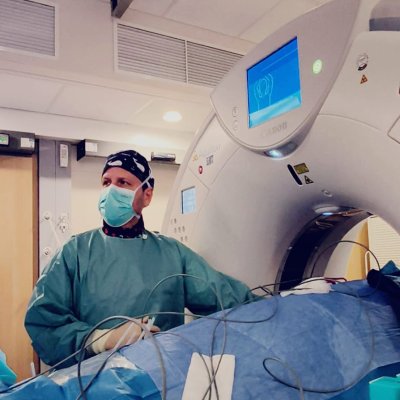
CHU Helora Site Jolimont
CHU (Centre Hospitalier Universitaire)La Louvière

Dr Frederic COHEN
Radiologue interventionnelAubagne, Marseille

Dr Alexia DABADIE
Radiologue interventionnelDr Arthur DAVID
Radiologue interventionnelNantes

Dr Vincent DUROUS
Radiologue interventionnelAnnecy, Argonay, Épagny

EMBOLILLE
Clinique privéeLesquin, Lille
Dr Cédric FOUSSIER
Radiologue interventionnelParis

Hôpital Européen Marseille
Clinique privéeMarseille

Dr Quentin LAFERTÉ
Radiologue interventionnelSaint-Quentin

Dr Thibaud LEFORT
Radiologue interventionnelLyon