Partial splenic embolization
Partial embolization of the spleen to treat severe hypersplenism, as an alternative to surgical splenectomy.
The information below is provided for general educational purposes only. It describes the procedure in general terms and may not apply to your specific situation. Only your interventional radiologist can provide you with personalized information adapted to your case.
What does this intervention involve?
Background and indications
Partial splenic embolization is offered for hypersplenism (excessive blood cell destruction by an overactive spleen) or symptomatic splenomegaly when surgery (splenectomy) is not desired or too risky.
Benefits
Partial preservation of splenic function (immunity), correction of blood count abnormalities (thrombocytopenia, leukopenia), minimally invasive alternative to splenectomy.
Procedure
A catheter is guided via the femoral artery to the splenic artery. Particles or gelatin are injected to embolize approximately 50-70% of the splenic parenchyma. The procedure lasts 1-2 hours.
Risks
Post-embolization syndrome (fever, pain, nausea), splenic abscess, pancreatitis, left pleural effusion.
Recovery and follow-up
3-5 day hospitalization, pain management. Blood tests and CT at 1 month.
Practical information
Local anesthesia. Hospital stay: 3 to 5 nights.
This information does not replace a medical consultation. Each procedure is adapted to the patient's individual situation. Your doctor will explain the specific details, expected benefits and potential risks during your consultation.
Doctors and centers/departments performing this intervention
18 doctors

Centre Hospitalier de Saint-Quentin
Centre hospitalierSaint-Quentin

CHU CHARLEROI
CHU (Centre Hospitalier Universitaire)Charleroi
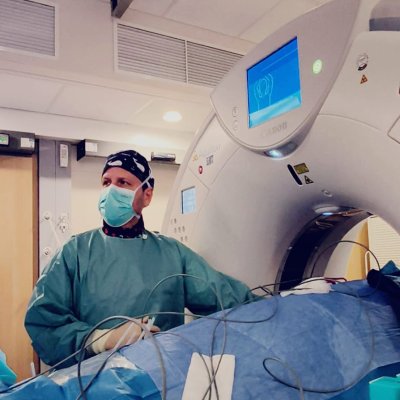
CHU Helora Site Jolimont
CHU (Centre Hospitalier Universitaire)La Louvière
Dr Frederic COHEN
Radiologue interventionnelAubagne, Marseille

Dr Alexia DABADIE
Radiologue interventionnelDr Arthur DAVID
Radiologue interventionnelNantes
Dr Vincent DUROUS
Radiologue interventionnelAnnecy, Argonay, Épagny
Dr Cédric FOUSSIER
Radiologue interventionnelParis

Hôpital Européen Marseille
Clinique privéeMarseille

Dr Quentin LAFERTÉ
Radiologue interventionnelSaint-Quentin

Dr Thibaud LEFORT
Radiologue interventionnelLyon
Dr Lucas MOSCATELLI
Radiologue interventionnelSaint-Paul