Percutaneous bone metastasis ablation
Percutaneous destruction of a bone metastasis, often combined with cement consolidation, for curative or pain relief purposes.
The information below is provided for general educational purposes only. It describes the procedure in general terms and may not apply to your specific situation. Only your interventional radiologist can provide you with personalized information adapted to your case.
What does this intervention involve?
Background and indications
Bone metastasis ablation is offered for painful metastases resistant to standard pain treatment, or in selected cases of oligometastatic disease (limited number of metastases) with curative intent.
Benefits
Rapid and lasting pain relief (effective in 80-90% of cases), bone stabilization when cementoplasty is added, and potential local tumor control.
Procedure
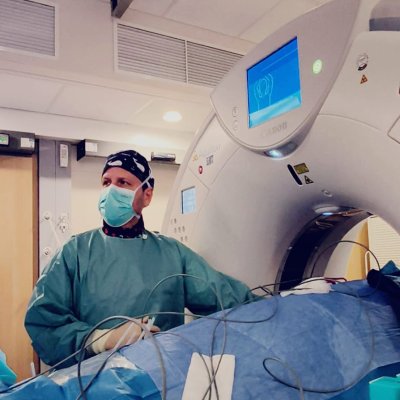
Under general anesthesia, one or more needles are placed in the bone metastasis under CT guidance. Destruction is performed by cryoablation, RF or microwave. Cementoplasty (cement injection) may be performed simultaneously to reinforce weakened bone. The procedure lasts 1-2 hours.
Risks
Risks include pathological fracture, nerve injury (particularly in the spine), bleeding or infection. Proximity to neural structures is assessed before the procedure.
Recovery and follow-up
1-3 day hospitalization. Pain relief is often noticeable within days. Follow-up CT at 1-3 months.
Practical information
General anesthesia. Hospital stay: one to two nights.
This information does not replace a medical consultation. Each procedure is adapted to the patient's individual situation. Your doctor will explain the specific details, expected benefits and potential risks during your consultation.
Doctors and centers/departments performing this intervention
16 doctors

Centre Hospitalier de Saint-Quentin
Centre hospitalierSaint-Quentin

CHU CHARLEROI
CHU (Centre Hospitalier Universitaire)Charleroi
CHU Helora Site Jolimont
CHU (Centre Hospitalier Universitaire)La Louvière

Dr Frederic COHEN
Radiologue interventionnelAubagne, Marseille

Dr Alexia DABADIE
Radiologue interventionnelDr Arthur DAVID
Radiologue interventionnelNantes

Dr Vincent DUROUS
Radiologue interventionnelAnnecy, Argonay, Épagny
Dr Cédric FOUSSIER
Radiologue interventionnelParis

Hôpital Européen Marseille
Clinique privéeMarseille
Dr Lucas MOSCATELLI
Radiologue interventionnelSaint-Paul

Dr Alexandre NÉROT
Radiologue interventionnelAnnecy, Argonay, Chambéry

Dr Matthieu PAPILLARD
Radiologue interventionnelGenève