Percutaneous desmoid tumor ablation
Percutaneous destruction of a desmoid tumor (aggressive fibromatosis) by cryoablation or radiofrequency.
The information below is provided for general educational purposes only. It describes the procedure in general terms and may not apply to your specific situation. Only your interventional radiologist can provide you with personalized information adapted to your case.
What does this intervention involve?
Background and indications
Desmoid tumors are benign but locally aggressive soft tissue tumors. Percutaneous ablation is offered for symptomatic tumors (pain, compression) when surgery is difficult or the patient prefers to avoid major intervention.
Benefits
Minimally invasive treatment preserving surrounding anatomical structures, good efficacy for pain and local control. Cryoablation is particularly suitable as it allows real-time visualization of the treated area.
Procedure
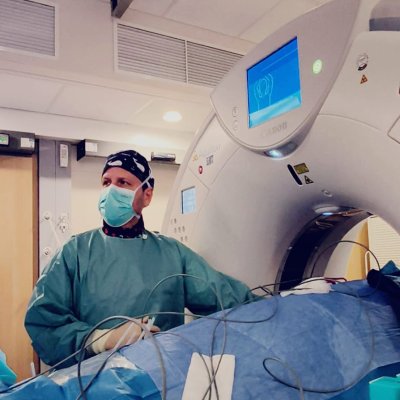
Under general anesthesia, one or more cryoablation needles are placed in the tumor under CT or ultrasound guidance. Multiple freeze-thaw cycles are performed. The procedure lasts 1-3 hours depending on tumor size.
Risks
Nerve, skin or adjacent structure injury, bleeding, infection. Risk depends strongly on tumor location.
Recovery and follow-up
1-2 night hospitalization. Follow-up MRI at 3 months then regularly to monitor tumor response, which can be slow (6-12 months).
Practical information
General anesthesia. Hospital stay: one to two nights.
This information does not replace a medical consultation. Each procedure is adapted to the patient's individual situation. Your doctor will explain the specific details, expected benefits and potential risks during your consultation.
Doctors and centers/departments performing this intervention
7 doctors
CHU Helora Site Jolimont
CHU (Centre Hospitalier Universitaire)La Louvière

Dr Alexia DABADIE
Radiologue interventionnelDr Arthur DAVID
Radiologue interventionnelNantes

Dr Vincent DUROUS
Radiologue interventionnelAnnecy, Argonay, Épagny
Dr Matthieu PAPILLARD
Radiologue interventionnelGenève

Service de radiologie interventionnelle - CHU de NANTES
CHU (Centre Hospitalier Universitaire)Nantes
Service de radiologie interventionnelle - Hôpital de Valenciennes
Centre hospitalierValenciennes