Percutaneous renal tumor ablation
Percutaneous destruction of a kidney tumor, most commonly by cryoablation, under CT guidance.
The information below is provided for general educational purposes only. It describes the procedure in general terms and may not apply to your specific situation. Only your interventional radiologist can provide you with personalized information adapted to your case.
What does this intervention involve?
Background and indications
This technique is offered for small renal tumors (generally ≤4 cm, stage T1a) in patients who are not surgical candidates or who wish to maximally preserve renal function. It is particularly useful for solitary kidneys, bilateral tumors or renal insufficiency.
Benefits
Ablation preserves more renal tissue than surgery, which is crucial for maintaining long-term kidney function. Recovery is fast and oncological outcomes are comparable to surgery for small tumors.
Procedure
Under general anesthesia, one or more needles are placed in the renal tumor under CT guidance. Cryoablation (freezing) is the most commonly used technique for kidneys. Two freeze-thaw cycles are performed. The procedure lasts 1-2 hours.
Risks
Complications include bleeding (perirenal hematoma), urinary tract injury, infection or, rarely, damage to a neighboring organ (colon, psoas muscle). Kidney function monitoring is performed.
Recovery and follow-up
1-2 night hospitalization. Follow-up CT scan at 1 month, 6 months, then annually for 5 years to monitor for recurrence.
Practical information
General anesthesia. Hospital stay: one to two nights.
This information does not replace a medical consultation. Each procedure is adapted to the patient's individual situation. Your doctor will explain the specific details, expected benefits and potential risks during your consultation.
Doctors and centers/departments performing this intervention
19 doctors
Dr Ignacio ANDRES CANO
Radiologue interventionnelRennaz

Centre Hospitalier de Saint-Quentin
Centre hospitalierSaint-Quentin

CHU CHARLEROI
CHU (Centre Hospitalier Universitaire)Charleroi
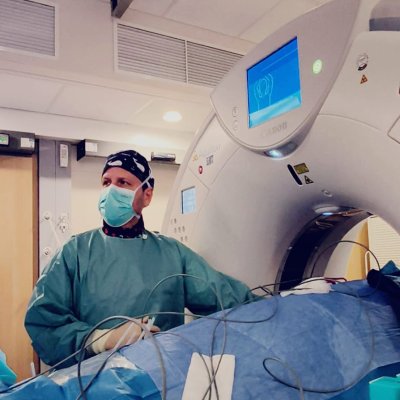
CHU Helora Site Jolimont
CHU (Centre Hospitalier Universitaire)La Louvière
Dr Frederic COHEN
Radiologue interventionnelAubagne, Marseille
Dr Arthur DAVID
Radiologue interventionnelNantes
Dr Vincent DUROUS
Radiologue interventionnelAnnecy, Argonay, Épagny

EMBOLILLE
Clinique privéeLesquin, Lille
Dr Cédric FOUSSIER
Radiologue interventionnelParis
Hôpital Européen Marseille
Clinique privéeMarseille

Dr Quentin LAFERTÉ
Radiologue interventionnelSaint-Quentin

Dr Thibaud LEFORT
Radiologue interventionnelLyon