Vertebral cementoplasty
Percutaneous injection of surgical cement into a vertebra weakened by a metastasis to relieve pain and consolidate the bone.
The information below is provided for general educational purposes only. It describes the procedure in general terms and may not apply to your specific situation. Only your interventional radiologist can provide you with personalized information adapted to your case.
What does this intervention involve?
Background and indications
Oncological vertebral cementoplasty is offered for painful vertebral metastases or those threatening spinal stability. It may be combined with tumor ablation.
Benefits
Rapid pain relief (often within 24-48 hours), vertebral consolidation and prevention of collapse or pathological fracture.
Procedure
Under local or general anesthesia, one or two large-bore needles are inserted into the vertebral body under CT and fluoroscopic guidance. Acrylic cement (PMMA) is injected under continuous fluoroscopic monitoring to verify proper distribution. The procedure lasts 30 minutes to 1 hour per level.
Risks
Cement leakage outside the vertebra is possible (into veins, spinal canal or adjacent discs), potentially compressing nerves or spinal cord in exceptional cases. Pulmonary cement embolism is rare. Infection is exceptional.
Recovery and follow-up
Same-day or next-day discharge. Weight-bearing and walking are allowed immediately. A control CT verifies proper cement distribution.
Practical information
Local anesthesia. Outpatient procedure (return home the same day).
This information does not replace a medical consultation. Each procedure is adapted to the patient's individual situation. Your doctor will explain the specific details, expected benefits and potential risks during your consultation.
Doctors and centers/departments performing this intervention
15 doctors

Centre Hospitalier de Saint-Quentin
Centre hospitalierSaint-Quentin

CHU CHARLEROI
CHU (Centre Hospitalier Universitaire)Charleroi
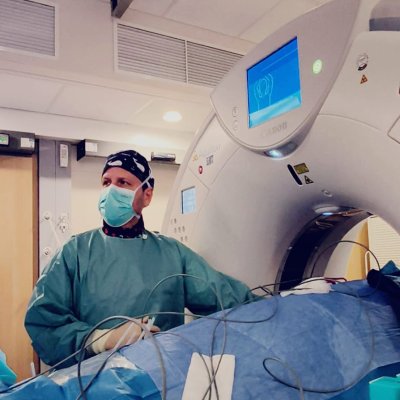
CHU Helora Site Jolimont
CHU (Centre Hospitalier Universitaire)La Louvière
Dr Arthur DAVID
Radiologue interventionnelNantes

Dr Vincent DUROUS
Radiologue interventionnelAnnecy, Argonay, Épagny

EMBOLILLE
Clinique privéeLesquin, Lille
Dr Cédric FOUSSIER
Radiologue interventionnelParis

Hôpital Européen Marseille
Clinique privéeMarseille

Dr Quentin LAFERTÉ
Radiologue interventionnelSaint-Quentin
Dr Lucas MOSCATELLI
Radiologue interventionnelSaint-Paul

Dr Alexandre NÉROT
Radiologue interventionnelAnnecy, Argonay, Chambéry
Dr Matthieu PAPILLARD
Radiologue interventionnelGenève