Prostatic artery embolization (BPH)
Prostatic artery occlusion to reduce prostate volume and improve urinary symptoms related to benign prostatic hyperplasia.
The information below is provided for general educational purposes only. It describes the procedure in general terms and may not apply to your specific situation. Only your interventional radiologist can provide you with personalized information adapted to your case.
What does this intervention involve?
Background and indications
Benign prostatic hyperplasia (BPH) affects the majority of men over 50 and causes urinary symptoms (frequency, weak stream, nocturia). Embolization is an alternative to surgical treatments (resection, laser) when medications are no longer sufficient.
Benefits
Significant urinary symptom improvement in 80-90% of cases, sexual function preservation (no retrograde ejaculation), outpatient or one-night hospitalization, rapid recovery (3-5 days).
Procedure
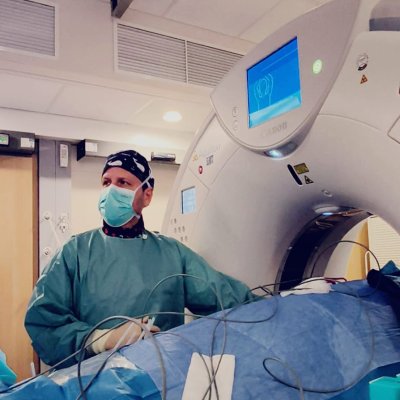
Under local anesthesia, a catheter is introduced via the radial (wrist) or femoral (groin) artery. The radiologist navigates to the prostatic arteries on both sides and injects microspheres to reduce blood supply to the prostate. The procedure lasts 1.5-3 hours, depending on vascular anatomy.
Risks
Transient pelvic pain and urinary burning (a few days), puncture site hematoma, urinary infection. Rare complications include bladder or rectal ischemia. No urinary catheter during the procedure is an advantage.
Recovery and follow-up
Same-day or next-day discharge. Follow-up MRI at 3 months with IPSS score evaluation (urinary symptoms). Improvement is gradual over 1-3 months.
Practical information
Local anesthesia. Outpatient procedure (return home the same day).
This information does not replace a medical consultation. Each procedure is adapted to the patient's individual situation. Your doctor will explain the specific details, expected benefits and potential risks during your consultation.
Doctors and centers/departments performing this intervention
18 doctors

Centre Hospitalier de Saint-Quentin
Centre hospitalierSaint-Quentin

CHU CHARLEROI
CHU (Centre Hospitalier Universitaire)Charleroi
CHU Helora Site Jolimont
CHU (Centre Hospitalier Universitaire)La Louvière

Dr Frederic COHEN
Radiologue interventionnelAubagne, Marseille
Dr Arthur DAVID
Radiologue interventionnelNantes

Dr Vincent DUROUS
Radiologue interventionnelAnnecy, Argonay, Épagny

EMBOLILLE
Clinique privéeLesquin, Lille
Dr Cédric FOUSSIER
Radiologue interventionnelParis

Hôpital Européen Marseille
Clinique privéeMarseille

Dr Quentin LAFERTÉ
Radiologue interventionnelSaint-Quentin

Dr Thibaud LEFORT
Radiologue interventionnelLyon
Dr Lucas MOSCATELLI
Radiologue interventionnelSaint-Paul